


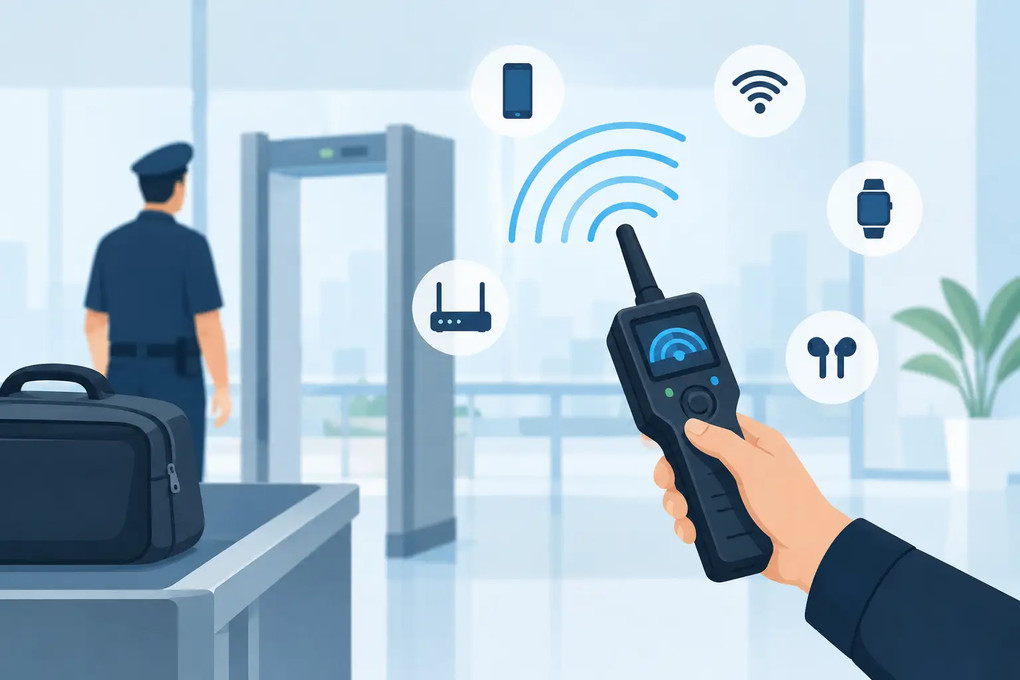
RF Signal Detector for Wireless Security Checks
13th Nov 2026
A hidden device does not need to be large to create a serious privacy or security concern. A camera, audio transmitter, GPS tracker, or unauthorized wireless device may be small enough to disappear into a room, vehicle, office, or rental property. An RF signal detector gives you a practical way to check an area for active radio-frequency transmissions before you assume the space is private.
For homeowners, managers, landlords, and professional users, the value is straightforward: an RF detector can alert you to wireless activity that should not be there. It is not a magic wand, and it cannot identify every device automatically. Used methodically, however, it is one of the most useful tools for locating active wireless surveillance equipment and other unknown transmitters.
What an RF Signal Detector Actually Does
An RF detector measures radio-frequency energy in the surrounding area. Wireless devices transmit RF energy when they communicate through Wi-Fi, Bluetooth, cellular networks, GPS systems, radio controls, or other wireless protocols. When a detector senses that activity, it typically responds with LED indicators, an audible alert, vibration, or a combination of all three.
The stronger the reading, the closer you may be to the source. Most detectors include adjustable sensitivity so you can begin with a broad scan, then reduce the detection range as you narrow down the location. That adjustment is what turns a basic alert into a useful physical search tool.
An RF detector does not tell you, with certainty, that a signal comes from a hidden camera. It detects the transmission, not the intent of the device. A wireless router, smartwatch, cordless phone, Bluetooth speaker, smart TV, wireless alarm sensor, or nearby cell phone can all create readings. The operator must separate normal signals from suspicious ones through a controlled inspection.
What an RF Signal Detector Can Find
The best use case is an active transmitting device. A Wi-Fi camera streaming live video, a Bluetooth audio device, a cellular tracker reporting its location, or a wireless microphone sending audio can all create detectable RF activity. Detection results depend on the device's frequency, power output, transmission pattern, distance, and the sensitivity range of the detector.
Wi-Fi cameras are often easier to locate while they are actively connected and transmitting video. A camera may send data continuously, or only when motion activates it. If you are checking a room and suspect a motion-activated device, move through the space naturally, open doors, change lighting where appropriate, and allow enough time for a possible device to wake up and communicate.
Some devices are more difficult to detect. A camera recording only to an internal SD card may not transmit any RF signal at all. A powered-off device, a device with a dead battery, or equipment programmed to transmit only at scheduled intervals may also remain quiet during a sweep. This is why a complete counter-surveillance check often combines RF detection with a camera-lens detector and a careful physical inspection.
How to Sweep a Room for Unknown Signals
Before scanning, reduce avoidable interference. Turn off or move known wireless devices when possible. Put your own phone in airplane mode, disable Bluetooth accessories, and temporarily power down nearby wireless equipment you control. You do not need to shut down an entire home or office, but the fewer known signals operating during the search, the easier it is to interpret what the detector finds.
Start With a Broad Baseline Scan
Set the detector to high sensitivity and walk the perimeter of the room slowly. Check walls, ceilings, windows, furniture, electrical outlets, smoke detectors, clocks, lamps, air purifiers, media equipment, and any object that seems out of place. Do not rush. RF signals can reflect from metal, glass, wiring, and appliances, so an alert from across a room is only a starting point.
Take note of areas where the alert consistently becomes stronger. Repeat the path once or twice to see whether the reading follows you or remains tied to the same physical location. A consistent increase near one object is more meaningful than an occasional alert in a room full of normal electronics.
Reduce Sensitivity as You Get Closer
Once you find a strong area, lower the sensitivity and rescan. Continue reducing it as you move closer to the strongest point. The goal is to shrink the detection field until the detector reacts only when it is very near the suspected object.
This step requires patience. If the sensitivity stays too high, every signal can seem close. If you lower it too aggressively, you may lose a weak transmitter. Make small adjustments and test from several angles. A genuine source should produce a repeatable pattern as you approach it.
Isolate the Object Before Drawing Conclusions
If a clock, charger, outlet device, or other object appears suspicious, inspect it without damaging property or handling anything unsafe. Where you have authority to do so, unplug the item or remove its power source and scan again. If the RF alert stops when that object is powered down, you have a strong reason to investigate further.
Be careful around electrical wiring, concealed wiring, and unfamiliar equipment. Do not open hardwired fixtures or tamper with devices in a space you do not own or manage. If a possible surveillance device is found in a hotel, rental, workplace, care facility, or other sensitive setting, document its location and contact the appropriate property manager, security professional, or law enforcement agency.
Choosing the Right RF Detector
Not every RF detector offers the same range or control. For basic residential checks, a compact detector with adjustable sensitivity, clear signal-strength indicators, and an audible or vibration alert is often enough. It should be simple to carry around rooms, vehicles, storage areas, and personal belongings.
For more demanding inspections, look for wider frequency coverage and better filtering. Modern wireless equipment can operate across several bands, including common Wi-Fi, Bluetooth, cellular, and GPS-related ranges. A unit designed for counter-surveillance should be able to respond to a broad mix of active transmitters rather than focusing on only one narrow frequency range.
Sensitivity control matters more than an impressive range claim. A detector that can be tuned down precisely is easier to use near a suspected source. Directional antennas can also help experienced users identify where a signal is strongest, especially in larger offices, vehicles, or multi-room properties.
A separate lens-finding mode is valuable when you are concerned about cameras that record locally instead of transmitting. These systems use flashing LEDs and a viewing filter to help reveal the reflection from a camera lens. RF detection checks for wireless activity; lens detection checks for optics. Together, they cover more real-world scenarios than either method alone.
Custom Wifi Spy Cameras carries counter-surveillance tools built for users who need practical controls, clear alerts, and discreet inspections rather than complicated laboratory equipment. The right model depends on whether you are performing an occasional home check, inspecting a vehicle, or conducting regular workplace security sweeps.
Know the Limits Before You Rely on It
An RF detector can produce false positives in any connected environment. Apartment buildings, hotels, offices, and urban neighborhoods may have dozens of nearby Wi-Fi networks and Bluetooth devices. Wireless signals can pass through walls, which means a reading may come from a neighboring room rather than the area you are inspecting.
It also cannot reliably identify the exact type of device without additional investigation. An alert could be a harmless smart appliance, a wireless printer, a nearby phone, or an unauthorized transmitter. The detector helps you locate and isolate activity. It does not replace visual inspection, network review, or professional technical analysis when the situation is serious.
Most importantly, no RF tool can detect a non-transmitting device at that moment. A wired camera, an offline recorder, or a device programmed to activate later may require a lens detector and close physical examination. Treat RF detection as one layer of a well-planned security check, not the only layer.
Use Counter-Surveillance Tools Responsibly
Use RF detection equipment only in spaces, vehicles, and property you own or are authorized to inspect. Privacy laws and recording laws vary by state, particularly when audio is involved. If you suspect illegal surveillance, avoid destroying evidence. Photograph the item in place if it is safe to do so, preserve relevant details, and seek qualified assistance.
A quiet signal reading should never replace common sense. If an object looks altered, has unexplained wiring, contains an unfamiliar memory card, or appears to be positioned toward a private area, inspect it carefully through lawful channels. The most effective security check is the one performed calmly, repeatedly, and with enough time to distinguish normal wireless activity from a signal that does not belong.